
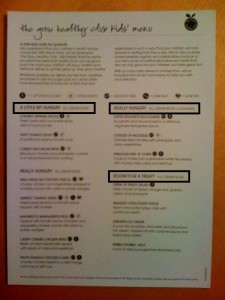
(A menu from a Holiday Inn in London - I added the black rectangles)
Many menus offer different portion sizes. Often, the portion sizes are described in relative (i.e., vague) terms such as small, medium, and large; tall and grande; appetizer-, lunch-, and dinner-sized portions; etc. Because I am somewhat used to seeing such descriptions, the menu shown above caught my eye. If you can read the text in the black rectangles (I apologize for the poor quality of the camera phone pic), it describes portion sizes based on how hungry one (or in this case one’s child) is feeling. The small plates are labeled “a little bit hungry,” the larger plates are labeled, “really hungry,” and the desserts are labeled, “room for a treat?.” We like the idea of using this type of “nudge” to encourage folks to think about how hungry they are before choosing a portion size
The thing with portion sizes labeled small, medium, and large is that there is a natural tendency to want more of something that we like and are ordering. Consciously or subconsciously, “more” tends to be equated with “better.” You like milkshakes? Then why order a small when you can get a large (usually for what seems like a nominal increase in price)? You like french fries? Then why not supersize your order? This choice architecture, or the way that the options are presented to you are designed to encourage you to order the largest size (no matter how large that size might be). The largest size is often presented as the default option, presented in the largest and most visually appealing way, and marketed as being available for only a small additional cost.
Now, this situation wouldn’t be such a problem if it was simply analogous to buying food in bulk where we could save money by purchasing more at a lower price. And it is possible to take advantage of large portion sizes in such a way by splitting a large single portion with a dining companion or having half of a portion size boxed up (at the beginning of the meal) to be eaten at a later time. However, more often than not, we fall into the trap of ordering more than we need and then “cleaning our plate.”
So, here are a few alternative ways for thinking about or replacing the typical small, medium, and large terminology
- (as above) little bit hungry, quite hungry, really hungry
- snack, meal, feast
- gonna eat again in an hour or two, gonna eat again in 5-6 hours, gonna skip a meal
- my activity today has been: sedentary, active, vigorous
A large serving might always sound better than a smaller serving (at least before you finish eating), but by thinking about your hunger level, when you plan to eat next, and your activity level for the day prior to ordering (or serving a meal at home), you can better link your needs to your choices and set yourself up for making decisions that are in your best long-term interest.
Cheers,
Larry