
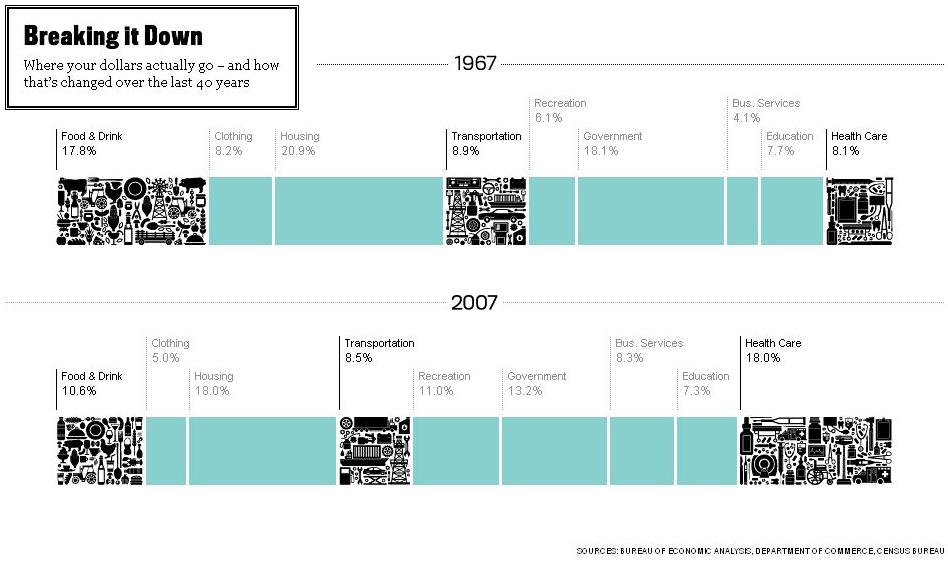
How we spend - graphic courtesy of The Atlantic
The April issue of The Atlantic includes an interesting article on how spending has changed from the 40′s-60′s to today (2007). Take a look at the graphics online (one of them and the link to the story is just above) and see if you notice any potential relationships (hint: pay attention to the largest effects on either end of the spectrum).
Yes, that’s right. In both an analysis of total consumer spending in 2007 relative to 1947 and in an analysis of where your dollars actually go from 1967 to 2007, the largest changes in spending have included spending less on food and spending more on health care.
So just how drastic have these changes been? Well, in one analysis, consumer spending on food and drink in 2007 decreased by almost 18% relative to 1947 levels, whereas spending on healthcare increased by 13%. In another analysis (see graphic above), the percentage of our budget spent on food and drink decreased by approximately 7% from 1967 to 2007, while the percentage of our budget spent on healthcare increased by approximately 10%. It is also noted that in 1967, 26% of what we spent on food went to those who actually made it (i.e., farmers and manufacturers) with 6% going to advertisers, lawyers, etc. In contrast to today (2007), only 14% of what we spend on food goes to the farmers and manufacturers who make it with 15% going to the other business services folks.
Now there are a number of possible interpretations of these data. The Atlantic states that the increases in healthcare costs are explained in part by the additional education that is now required of folks who want to get into the healthcare field. We could also talk about the increasing use of expensive procedures such as MRIs or how decreases in food and drink costs are perhaps due to improved efficiency or crop yields. Nonetheless, it is very interesting to note that as we have spent less on food, particularly with less going directly to the farmers and other folks who produce our food, the amount of money that we have spent on healthcare has moved in the opposite direction. I would also venture to say that most of the healthcare spending is somewhat involuntary in nature. That is to say most people spend money on healthcare when they have to because they are ill. This is likely in contrast with most spending on food and drink, which is largely more voluntary in nature, as you may choose whether to purchase (more expensive) fresh fruits and vegetables or a (less expensive) box of hamburger helper.
My interpretation of these data is that when we cut corners on what we pay for our food, we make up for it in what we have to pay for healthcare. And, I don’t know about you, but I would much rather spend my time forking over dollars to a farmer at the market for fresh produce than waiting in a dingy doctor’s office to incur large medical bills.
Which would you prefer?