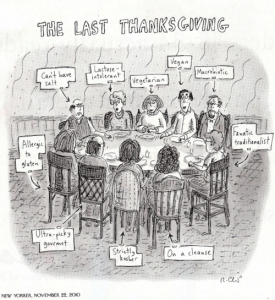
More and more often I hear people say “Thanksgiving is my favorite holiday of the year.” To me, Thanksgiving remains pure – it’s about family and food. In fact, I’m not sure what I look forward to more: Seeing family, or seeing them truck in their proud contributions to the feast. I kid.
Fullness and Sleepiness
For many, this holiday represents gluttony. We all have familiarity with the discomfort of overeating (a common reaction is to ask ‘Why did I do that?’). When you do overeat, you experience painful stomach distension and other digestive issues, and in addition, the quantity and richness of a meal can lead to severe sleepiness. Interestingly, the characteristic sleepiness induced by a Thanksgiving meal is usually attributed to the high tryptophan content in turkey meat; however, it’s more likely that the sleepiness one feels derives from an immune reaction to excessive calorie consumption. That’s right, when you overeat it triggers an immune reaction producing soporific (sleep inducing) cytokines.
A New Pattern of Eating?
Ok, ok, so is all that really that bad? Besides, this is a once-a-year celebration. Perhaps there is another more insidious issue with an enormous Thanksgiving dinner. For many, the holidays represent the time when they gain all their weight for the year. Over time, five pounds of weight gain per year can move someone (depending on their size) from a normal weight to nearly obese! Obviously, you’re not going to gain all this weight from one Thanksgiving meal, but it is possible that this one meal can kick start a new eating pattern over the next few months.
Overeating in Response to the Cold Temperatures?
Many species store up fat for the winter. In fact, there is a theory that the drop in outside temperature signals greater hunger levels. A response to this type of environmental signal would be favorable in ancestral times, because food availability becomes scarce during the cold winter months. If you can store a little extra fat during the winter, it probably translated to greater survival ability. However, in this day and age, many of us more fortunate people do not experience vicissitudes in food availability so a desire to eat more may represent a problem instead of a survival benefit.
So what do we do? It may seem natural to eat more during the cold winter month and certainly Thanksgiving is the national holiday of bounty and consumption. Additionally, I really want to enjoy Grandma Marie’s famous mash potatoes and I know that, as I write this blog post, she pouring a lot of love into those mashers for all of us to enjoy tomorrow.
Variety Makes Us Eat More
One of the issues with a characteristic Thanksgiving day celebration is the large variety of food options made available at the dinner table. Research shows that the more food options you present research subjects, the more likely the subjects will overeat. Interestingly, even if you take the same potato chips and you put them in 12 bowls, instead of 4 bowls, subjects are likely to eat more. Therefore, all it takes is the perception of variety to alter our eating behaviors. Ok, so variety can promote overeating and so can the implicit suggestion that overeating is the correct thing to do on a day like Thanksgiving. What can a person do to optimize their own gustatory experience while minimizing the consequences?
My New Approach
Formerly, I would gorge during Thanksgiving dinner but the last few years I aimed to eat a better amount. I actually enjoy Thanksgiving more now because I find it preferable to eat the right amount instead of stuffing myself, well, like the turkey. I aim to peak my own ingestive and post-ingestive experience by attempting to balance taste diversity, stomach satisfaction and my after-the-meal experience. I sample everything available on the kitchen counter because I know each person in attendance worked hard to create something wonderful for the rest of us to enjoy. I take a small amount of each item and then I wait at least 15 or 20 minutes before deciding to go back for a little more of my favorite dish. It might be a little fuller than I usually am after a meal but I don’t feel like passing out into a dietary-induced coma like I would during Thanksgiving of yore. Lastly, at our household, we’ve made it a part of our tradition to take a family walk after the meal. The common reaction from everyone in the group is the same, “this feels so good!”
Overall, Thanksgiving is a more comfortable and enjoyable experience for me now that I have a sound approach to the day, and I truly look forward to it more than ever before.
From all of us here at Dan’s Plan, we wish you a wonderful day tomorrow and we’d like to take this opportunity to express our gratitude for your interest in our program and in your own health!
I like you,
Dan