
Many people care about the amount of sugar in their diet for health- or weight-related reasons. However, fewer people are likely aware of the effects that dietary sugar can have on cognitve processes like attention and memory. Until recently, I was one of those people.
Now, don’t get me wrong, I was certainly aware of the fact that when I start to feel hungry, my ability to concentrate on a demanding task tends disappear. However, what I wasn’t aware of was the work by David Benton and colleagues who have carefully studied the effects of sugar on concentration and memory. Today we’ll briefly review three of his studies.
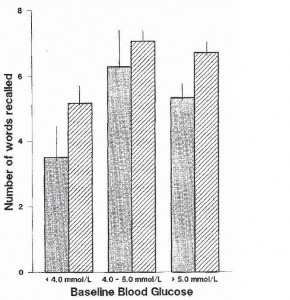
1. In this study from 1993, they showed that baseline blood glucose levels (whether rising of falling) affect memory. People with blood sugar levels in the middle of a range remebered more words in a memory task as compared to people with low or high blood sugar levels.
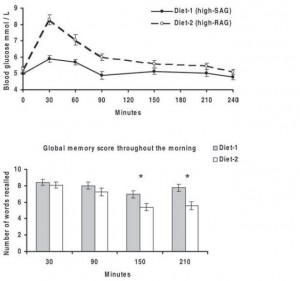
2. Remember yesterday when talked about glycemic index and glycemic load as measures of how much sugar your body actually “sees” and how sugar can affect your body in different ways? In this study from 2003, Benton’s group studied the effects of two different meals on blood sugar and memory performance. The meals were pretty well-matched on the amount of calories, fat, protein, and carbohydrates they contained, but they differed quite a bit in terms of glycemic index. One meal (diet 1) had a glycemic index that was about 35% lower than the other (diet 2). What they found was that diet 1 (SAG stands for slowly available glucose; RAG stands for rapidly available glucose) with the lower glycemic index resulted in a smaller increase in blood glucose levels, whereas diet 2 with a higher glycemic index resulted in a larger increase in blood glucose levels. Interestingly, 2.5 and 3.5 hours later, they found significant differences in the effects of the two meals on memory. Consumption of the higher glycemic meal (diet 2) resulted in worse performance on the memory test.
3. This third study from 2007 brings it all home. In this study, Benton’s group provided three different types of meals to children in school and measured things like memory, attention, frustration in response to a difficult task, and classroom behavior. The meals were three different breakfasts that had a similar number of calories, but glycemic loads that were either high (corn flakes, low-fat milk, sugar, waffle, maple syrup), medium (scrambled egg, slice of bread, jam, low-fat spread, low-calorie yogurt), or low (slice of ham, slice of cheese, slice of bread, low-fat spread). The results of this study showed that two to three hours after the low glycemic load breakfast had been consumed, performance on the tests of memory and attention were better, there were fewer signs of frustration, and there was more time spent on task when working individually in class.
So, what do I take away from this? 1. Sugar and the type of sugar consumed can affect cognitive functions like memory and attention. 2. The reasons for providing nutritious meals to children in schools might extend beyond those related to hunger and ethics and might actually help improve academic performance. And, 3. Limiting the amount of (rapidly available) sugar you consume during this holiday season might help keep your memory sharper and your frustration levels lower. And we can all use some of that during this busy time of year.
Happy Holidays,
Larry